
Journalism
» Latest post in Features:
The Long Read: Landmark History Gives the Middle East Perspective of the First World War
On November 11, 1914, Sheikh Al Islam Ürgüplü Hayri Bey, the supreme religious authority in the Ottoman Empire, posed a dramatic question in the Fatih Sultan Mehmed Mosque, one of the most venerable monuments on the Istanbul skyline. The question, and the emphatic one-word answer it generated, would affect the lives of millions of Muslims, as well as their adversaries, across the Middle East over the next four years.
“Question: When it occurs that enemies attack the Islamic world, when it has been established that they seize and pillage Islamic countries and capture Muslim persons and when his Majesty the Padishah of Islam [the Ottoman Sultan Mehmed V] thereupon orders the jihad in the form of a general mobilisation, has jihad then … become incumbent on all Muslims and has it become an individual duty for all Muslims in all parts of the world, be they young or old, on foot or mounted, to hasten to partake in the jihad with their goods and money?
“Answer: Yes.”
Traditionally, historians have downplayed the significance of the ensuing German-orchestrated jihad against the Allies, to the extent that it has been branded irrelevant to the wider war effort. Certainly it did not have the devastating effect wished for by its architects and, on this purely military level, it can be contrasted with the more immediately effective British-sponsored uprising of the Arabs against the Ottomans, their co-religionists and long-standing colonial overlords.
Yet this explanation, says Professor Eugene Rogan, the author of a new landmark study – The Fall of the Ottomans: The Great War in the Middle East, 1914-1920 – fails to take into account the effect the jihad had on the Entente Powers or Allies.
“I think it failed to provoke a global Islamic uprising, but the way it played on British and French war planners was very significant, right through to the fall of Jerusalem in November 1917. The British were preoccupied that defeats at the hands of the Ottomans might provoke uprisings by colonial Muslims in India and Egypt – and it really shaped a lot of their wartime planning. So to say the jihad was irrelevant needs revising.”
The uniquely western perspective of fighting on the Ottoman Front, long a neglected and underrated theatre of the First World War with the exception of the numerous works about Lawrence and the Arab Revolt, has been equally in need of revision. Just as for many Europeans, particularly the British and French, the Great War is popularly known almost exclusively as a Western Front affair, so with the war in the Middle East, European and especially British historians have tended to see the conflict through a British lens. Thus we have those hoary staples of “Churchill’s debacle” at Gallipoli; “Townshend’s surrender” at Al Kut, the most ignominious in British military history; “Maude’s entry” into Baghdad in March 1917, ending 383 years of Ottoman rule; “Allenby’s conquest” of Jerusalem in November that year. And, of course, that most enigmatic and quintessentially British figure, with a liberal sprinkling of Hollywood stardust, “Lawrence of Arabia”, long lionised by Brits as the leader of the Arab Revolt. Arabs, it hardly needs explaining, have consistently and vigorously contested this view, including most recently the distinguished Iraqi historian Ali Allawi in his 2014 biography Faisal I of Iraq.
This Eurocentric approach to the war in the Middle East tends to be parochial to the point of one-sided, a narrow perspective which Rogan is keen to widen. While David Fromkin’s A Peace to End All Peace (1989) reflected the classic view from British archives, Kristian Coates Ulrichsen’s The First World War in the Middle East (2014) offered a broader canvas. With Rogan, Gallipoli, Kut and Gaza now rightly become hard-won, resounding Ottoman victories rather than heroic British defeats. Far from proving the key to a swift end to war through a lightning defeat of the “Weak Man of Europe”, as the Allies had anticipated, the Ottoman Front only succeeded in lengthening – and vastly broadening – the greater conflict, claiming millions of soldiers from the Entente and Central Alliances.
What is especially welcome in this study is the long overdue focus on the experiences of Turkish and Arab soldiers and civilians during the war, culled from a series of recently published diaries and memoirs. During the past 10 years, perhaps 30 Ottoman soldiers’ diaries have been published in Turkey, counterparts to visceral British works such as P W Long’s Other Ranks of Kut (1938). These are alternately harrowing, heart-rending, sometimes amusing, but always intensely human documents. Rogan says they were “the most exciting part of writing the book. They allow us for the first time to approach the common soldier’s experience of fighting, and what’s so exciting are the parallels between what they write and what western soldiers write – we’ve never had it from both sides of the trenches before.”
Thus we hear the voices of ordinary men such as Corporal Ali Riza Eti, a Turkish medic called up for military service to fight the Russians at Köprüköy, the first Ottoman battle of the First World War in November 1914. Eti transcribed the terrifying symphony of bullets as civ civ civ. “As it was my first day [of fighting], I was very afraid of dying,” he noted in his diary. “With each civ I broke out in a sweat from my teeth to my toenails.”
French and Ottoman soldiers’ diaries bear common witness to the terror of hearing the enemy digging under their lines. “The Turks wrote a lot of poetry too, much of it very bad, like that of the soldiers they were fighting,” says Rogan. “The experience was so big it seemed to defy prose so they resorted to poetry to do justice to it.”
Rogan charts how the emerging Arab movement pressing for rights for Arab subjects within the Ottoman Empire came under ever more severe Young Turk repression in the lead-up to the Great War. Tens of thousands were exiled for their political views and dozens were hanged in Beirut and Damascus in 1916. Increased Ottoman suppression, combined with the hardship of the war years, fuelled increasingly separatist views among the Arabs.
Though sensitive to the general sophistication of Ottoman rule, Rogan does not pull his punches on the Armenian genocide of 1915. The chapter detailing “the annihilation of the Armenians”, with systematic massacres of males who were 12 years and over, often within sight or hearing of their womenfolk, sounds an eloquent riposte to long-standing Turkish denial of these “crimes against humanity”.
T E Lawrence famously considered the Arab Revolt “a sideshow of a sideshow”. By contrast, Rogan demonstrates that the Ottoman Front writ large was unquestionably an international affair that transformed Europe’s Great War into the First World War.
Here the British made common cause with South Asians, North Africans and New Zealanders, Australians, Senegalese, Sudanese and the French to fight a polyglot Ottoman army containing Turks, Arabs, Kurds, Armenians and Circassians. The Ottoman Front was “a veritable tower of Babel, an unprecedented conflict between international armies”.
Much of the turmoil currently convulsing the Middle East can find its echoes on the region’s battlefields a century ago. “What we forget was that the war was fought in many areas of the Middle East,” Rogan says. “There was fighting that affected people’s daily lives in Iraq, Syria, Lebanon, Egypt, Jordan, Palestine, Yemen, across the Hijaz, in Iran and in Turkey. The number of people touched by the war counted in the millions.”
Death came through disease, spread by the movement of huge armies, through famine and through direct conflict.
Another argument that comes in for intense re-examination concerns British wartime partition plans, which are typically considered “deeply duplicitous” in promising the same land to multiple parties. It is only by studying the series of different diplomatic agreements within their immediate military context, Rogan convincingly argues, that it becomes clear that diplomacy consistently was playing second fiddle to the overriding objective of winning an increasingly murderous war.
Thus the Constantinople Agreement of 1915, in which France and Britain promised Russia the prizes of Istanbul and the Dardanelles, reflected Allied confidence in a swift capture of the Ottoman capital. The protracted Hussein–McMahon Correspondence with the Hashemites in 1915-16 was engendered by Britain’s need for an Arab ally to counter the rabble-raising Ottoman jihad. Then came the Anglo-French Sykes-Picot Agreement of 1916 to carve up the Ottoman Middle East, struck in anticipation of an imminent Ottoman collapse that then proved stubbornly elusive. The ominous and conflicting Balfour Declaration of 1917 was a belated effort to recalibrate Sykes-Picot and secure British rule for Palestine. In Rogan’s words: “Britain was not thinking about drawing up borders in the Middle East so much as defeating the Germans.”
With the war won, and the ailing Ottoman Empire on its deathbed, the Great Powers turned avaricious eyes on the post-war prize of the Middle East. To the victors the spoils. In the last years of Sunni Muslim Ottoman rule, from the Young Turks revolution of 1908, the mixed populations of the Middle East had been represented in Istanbul on equal terms. The traditional dhimmi status for Jews and Christians had been abolished. Now Muslim rule gave way to European imperialism. The new masters were determined to snuff out the aspirations for Arab independence they had ignited only a couple of years earlier.
For Rogan, the conflict has left a distinctly baleful legacy in the region. “I think the Middle East has suffered more from the enduring consequences of World War I than practically any other part of the world,” he says.
Although the British and French successfully created what proved to be a remarkably resilient state system in which borders survived virtually intact for a century, they also left a legacy of unresolved national issues, which have continued to destabilise the region. Stable on one level, the long-lasting borders have engendered multiple conflicts on the other, notably with Palestine and the Kurds.
In fact, the legacy of the Great War in the Middle East extends far beyond Israel, the Palestinians and the Kurds. Lebanon emerged with the seeds of sectarian conflict planted within its own borders, vulnerable to ambitions from a Syria that was never reconciled to its loss.
Perhaps nowhere, though, has been as bloodied and scarred by its modern history as Iraq, conceived by the British as a union between the three related but separate Ottoman vilayets or provinces of Mosul, Baghdad and Basra. After a brief period of hope under a fledgling monarchy that lasted from 1921 to 1958, Iraqis have not been able to break the ensuing vicious cycle of revolutions, coups, wars and dictatorship. They are now engulfed by a sectarian conflict that traces its origins back more than 1,200 years before the Great War, to the Battle of Karbala in AD680, the crystallisation of the Sunni-Shia division.
Last year, Europe embarked on a four-year commemoration of the First World War. In the Middle East the centenary has been met largely with silence rather than celebrations of victories or commemoration of losses. There are other, more immediate conflicts to concentrate on. “It’s the forgotten war because it’s seen as someone else’s war even though it was fought on their soil and it was their men fighting and dying,” says Rogan. The people of the region had not chosen to get involved in this war. “World War One was the misfortune that led to the fall of the Ottoman Empire and the rise of European imperialism and it’s remembered as a period of tremendous suffering.”
This is a formidable narrative history, written with great verve and empathy. Through its meticulous scholarship and its deft weaving together of the social, economic, diplomatic and military history of this neglected front, The Fall of the Ottomans provides an engrossing picture of a deadly conflict that proved catastrophic for the peoples of the region.
Surveying the state of the Middle East a century after the conflict, Rogan argues the basic peacetime challenge of generating jobs and economic growth for a young and rapidly expanding population has been frustrated by numerous, currently overwhelming setbacks.
“What prevents the region from addressing those legitimate challenges are layers and layers of political problems and regional conflicts that seem to drive the prospects of a free and prosperous region deeper and deeper into the future,” he says. “With the conflicts in Yemen, Syria, Iraq and Libya – and with political volatility in Egypt, Tunisia, Lebanon, Jordan and Algeria – I think everyone is rational to be pessimistic about the prospects for the region. None of these problems have a short-term solution.”
• Eugene Rogan will attend the Emirates Literature Festival in Dubai on March 4. He will take part in a panel discussion ‘100 Years On: Continuing Reverberations in the Arab World’ as well as speak about his own work. For more information, visit www.emirateslitfest.com.
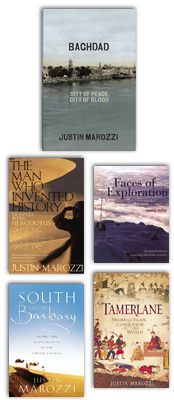
Justin Marozzi is the author of Baghdad: City of Peace, City of Blood.
[Read more, or see all Features]
» Latest post in Travel: How to Survive a Kidnapping – Top 10 Tips1. Make sure your wardrobe is up to it. If you happen to be nabbed in the Sahara, for example, think silk and linen to combat those sun-baked temperatures and impress your captors. Get the crumpled look going early on. Chances are you aren’t going to be changing your clothes much over the next few weeks anyway. As far as sensible footwear is concerned, I find carpincho loafers work well in North Africa. Crocodile loafers are likely to chafe with all that sand. A panama in the desert is a bit Little Englander. Go native with a pristine white shish, which can double up as scarf, handkerchief and sheet (see 2 below). Cold-weather kidnappings can pose more of a challenge sartorially. If you’re heading into freezing climes, pack some fur. It doesn’t hurt to cut a dash.
2. Don’t expect too much in the way of decent bed-linens. It’s unlikely your new hosts will be able to offer you vintage metis linen sheets, rinsed in lavender water, from Provence. Although this can be a cruel blow, lower your expectations and you may be pleasantly surprised. The damp quilt I had the good fortune to be lent during my recent, all too brief stay with the Touareg tribesmen of southern Libya did the job admirably. I took pleasure in the homemade patchwork and wayward stitching.
3. Be polite but firm. By all means suck up to your captors – but only up to a point. No one likes a toady. You don’t want to let the miserable people who have dared to capture you know that you are worth squillions – and therefore a stupendously large ransom. Nor, however, should you be so self-effacing that you come across as a feeble little nothingburger. They may just slit your throat and be done with it.
4. Travel light. Although I rarely like to be separated from my Globetrotter suitcase, life is a lot simpler if you don’t have too much on you when the hijackers jump into the road waving AK-47s in your face. They’re only going to steal it anyway.
5. Think about an escape. Initially I felt rather pathetic not taking my captors on, mowing them all down with a machine-gun and hightailing it back to Tripoli for a restorative cup of tea and apple-flavoured shisha. A growling Sir Wilfred Thesiger would surely disapprove of such inaction, I thought. Then I thought about it again. Sixteen armed young men with Kalashnikovs, who knew the desert like the back of their hands versus one Brit and his fortysomething Libyan friend, accompanied by wife and two-year-old son, who hadn’t got a clue where they were. The conclusion led to 6 below.
6. Enjoy the hospitality. Some people would pay extremely good money for an adventure like this. You’re getting all this for free. Soak it all in. Remember that unrepeatable sunset in the sand-dunes, that image of a crescent moon swinging into a star-filled sky. Join your new friends around the campfire, swap a few war stories and tell a few jokes to lighten the atmosphere. This could be your only kidnapping. Treat it as though it’s your last.
7. Ask your kidnappers if you can take notes – insist on it – and make sure you have a decent pen and writing paper to hand. A Moleskine notebook will do the trick. Fountain pens are preferable but will require a decent supply of ink that may not be forthcoming. Turn the whole thing into an extended interview. Think experience of a lifetime. Think life-enhancing adventure. Think book deal, talk shows and shameless publicity.
8. Get a good agent. See 7 above.
9. Learn some Horace. If you can reel off a few stanzas in Latin, you’ll bamboozle your captors and/or impress them beyond reason. Remember that lovely moment on 26 April, 1944 when the great warrior-writer Major Patrick Leigh Fermor kidnapped the German General Heinrich Kreipe on Crete. During the 18-day manhunt that followed, the general started murmuring his way through an ode by Horace. Paddy cut in and reeled off the remaining stanzas – in Latin. “We had both drunk at the same fountains long before; and things were different between us for the rest of our time together.” Quite so.
10. Take a tip from Islam and come to terms with the fact that you are no longer master of your own destiny, if you ever were. It’s a liberating discovery. Your life is now in the hands of almighty Allah. He may let you off. He may not. You may be returned to your loved ones before you can say, “Call that a kidnapping? Is that it?” Equally, you may be for the cosh, in which case if you are male 72 doe-eyed virgins will soon be consoling you for your loss of life. It could be worse.
Justin Marozzi was briefly hosted by the Touareg in southern Libya. He is the author of South from Barbary: Along the Slave Routes of the Libyan Sahara. His most recent book is The Man Who Invented History: Travels with Herodotus. He is writing a history of Baghdad for Penguin. www.justinmarozzi.com; Follow him @justinmarozzi
[Read more, or see all Travel]
» Latest post in Reviews: The Libyan Revolution and Its Aftermath describes the fragile state of post-Qaddafi LibyaAmong the various mementoes accumulated from many visits to Libya over the years, a massive broken padlock is the starkest reminder of the 2011 revolution. I took it from the notorious Abu Salim prison in Tripoli shortly after the fall of the Qaddafi regime. Macabre on one level, it nevertheless seemed an apposite symbol of incarceration and liberation, a bolt of light after four decades of gloom and despair. The fact that it was made in Italy, the former colonial power and oppressor, only added to the symbolism.
Walking through the prison provided a brief, harrowing glimpse into the shattered lives of those who had dared to challenge the regime. The sickly smell of disease was overpowering. Bottles of medicine were scattered everywhere. We walked through the cells with a middle-aged Libyan man, a former prisoner who had come to revisit the scene of the crimes. He broke down in tears as we roamed through the complex, recalling the cruelty and injustice he had suffered.
Abu Salim occupies a prominent place in the hierarchy of atrocities perpetrated by the Qaddafi regime. It was here, in 1996, that 1,200 prisoners were killed in cold blood, mowed down by machine guns, forklifted into refrigerated trucks and driven away.
Libyans have long memories. The legacy of that massacre lived on, so much so that Abu Salim proved the touchpaper for the revolution. Street protests by relatives of those who had been killed swelled into a broader uprising that erupted in the eastern city of Benghazi in February 2011, fuelled by the arrest of one of the lawyers who represented the families. Then came Colonel Qaddafi’s blood-curdling warning of more massacres, a strategic miscalculation that drew in Nato, hastened the demise of the regime and cost him his life.
Abu Salim had other unintended consequences. It incubated a generation of religious extremists, nurturing over many years the narrow Salafist ideology that is a significant, but by no means the only, reason for the country’s current collapse into turmoil. In an intensely revealing chapter in The Libyan Revolution and Its Aftermath, Mary Fitzgerald, an Irish Times correspondent who has spent the past year living in Libya, chronicles the bewildering internal battles between the various militant factions whose attempts to reconcile differences within an umbrella movement failed and fractured, a microcosm of the new post-revolutionary Libya.
It isn’t difficult to discern a visceral dislike of democracy among this constituency. Some sent death threats – the lingua franca of their political discourse – to members of the National Transitional Council, or what they called, in a play on its Arabic name, the Majlis Al Wadani – Pagan Council.
Death threats and executions have since proliferated in eastern Libya, the headquarters of both religious militants and separatists, notably the killing of the United States ambassador Chris Stevens in 2012. If anyone doubted that the jihadists of ISIL could extend their reach into Tripoli, the bloody January 27 attack on the Corinthia Hotel, long a redoubt for local politicians, diplomats and foreign businessmen, served as another reminder that when national politics stall, the terrorists move in.
The attack also revealed the deadly consequences of the Libyan state’s loss of the monopoly of violence. Once the conservative hardliners had suffered heavy defeats in last summer’s elections, they quickly revealed their true colours, refusing to recognise the results, forming the armed Libya Dawn Alliance and seizing Tripoli. The election winners relocated to the eastern city of Tobruk and took up the name Dignity. Hence the two parliaments, the two notional governments, the two leaders in two cities. A new Dawn in the West, Dignity in the East – with little prospect in the short term of realising either. Pity the ordinary Libyans, 400,000 of whom from a population of six million have been displaced.
So where did it all go wrong? How did we go from euphoria to dystopia so quickly?
These are questions this book seeks to answer and in doing so it provides the most complete picture we have yet had of the Libyan revolution and its aftermath. The contributors are an expert bunch, ranging from the academic and Libya historian Dirk Vandewalle to Ian Martin, the United Nation’s former chief in Libya. Peter Cole, the lead editor, was the International Crisis Group’s senior analyst in Libya in 2011-2012. All have significant recent experience of post-Qaddafi Libya.
At times some of the language can descend into academic or think-tanky jargon, such as “sub-national identities and narratives” and “state and nonstate actors”, but this is a minor cavil in an otherwise compelling and troubling read.
Libya has long had a troubled relationship with its minorities and Libyans frequently exhibit what, by western standards, would have to be judged racist contempt towards both the Tebu and Tuareg tribes of the south. Though indigenous to what is today Libya, both groups were deliberately marginalised by the Qaddafi regime – an explicitly Arab affair, as the country’s ludicrous then-name, the Great Socialist People’s Libyan Arab Jamahiriya, made clear. Tebu and Tuareg alike suffered discrimination with regards to housing, education, employment and even freedom of movement. Hopes that the revolution would redress these old injustices have proved bitterly wide of the mark.
“I’m not optimistic about getting what we dream for,” one Tebu tribesman says. “The stability of the south depends on Tebu rights,” warns another, “and Libya’s stability depends on the south’s stability.”
Instead, the south has become a dangerous place with Tebu and Tuareg among the protagonists in both legal and illegal trade – drugs, human trafficking, kidnapping and terrorism. The shock waves of Qaddafi’s removal have spread far beyond Libya into neighbouring Algeria, Mali and Niger.
To make matters worse, Al Qaeda and ISIL fighters have inserted themselves into the killing and kidnapping mix. It is little wonder that Bernardino León, the UN’s special envoy to Libya, is warning that the country is running out of time – not to mention foreign reserves. Oil production in the holder of Africa’s largest reserves is now below consumption levels. “The general impression is that the country is very close to total chaos,” León said after the Tripoli hotel attack.
Amid the current conflict, are there any reasons for optimism – an all too scant commodity in the Middle East these days? Donning the historian’s hat and taking a longer view, one could credibly argue that after 43 years of eviscerating dictatorship, it takes more than a couple of years for a country to recover. Revolutionary euphoria does not of itself a stable new country make. It will take time to rebuild after the annihilating Qaddafi dictatorship.
Yet the same historian could point to far earlier fault lines in Libya, noting the relative novelty of Libya as a nation state, with the three Ottoman provinces of Tripolitania in the west, Fezzan in the south and Cyrenaica (Barqa in Arabic) to the east persisting into the 20th century and independence only coming in 1951. Of Libya’s 60 years as an independent state until the 2011 revolution, 42 were under Qaddafi.
With the dictator gone, previously suppressed identities have surged forth, many of them advanced by their own supporting militias at the point of a Kalashnikov. Ancient ethnic and cultural divisions between East and West, between the settled population of the littoral and desert Arab Bedouin, between Arabs and Amazigh Berbers, between Arabs and the Tuareg and Tebu minorities, have all resurfaced and been allowed to sharpen in the three years since Qaddafi’s fall. The creeping extremism in the East and the superimposition of ISIL onto this fragile terrain only darkens the outlook.
One of the strengths of this book is its accumulated analysis of the enduring strength of tribalism, regionalism and religious conservatism within Libya, together with the ethnic politics of the Amazigh, Tebu and Tuareg, and how these centrifugal forces have stretched and strained an elastic Libyan national identity since 2011. It certainly challenges the view that Libya has a more or less homogenous society – it has no sectarian splits of the sort that are currently torturing Iraq and Syria – which in turn makes it more likely than most of its Arab Spring counterparts to make a successful transition from dictatorship to something more moderate and inclusive.
“If Libya can develop institutions that contain the political dialogue or disagreement between various strands, then a bright future awaits it,” the editors argue. By the end of this book, however, one feels less confident of such an outcome in the near term. The tragedy of the Libyan revolution and its bloody aftermath is that it didn’t have to be like this.
Justin Marozzi was an adviser to Nato and the NTC during the Libyan revolution, which he reported on for The National and other media. His first book, South from Barbary: Along the Slave Routes of the Libyan Sahara, was an account of a 2,000-kilometre journey by camel and a history of the desert slave trade.
This book is available on Amazon.
thereview@thenational.ae
[Read more, or see all Reviews]